Tewari Eye Centre, Sector-55, Noida
The TECNIS Monofocal 1-Piece is a standard, high-quality cataract lens. It focuses sharply at one distance, usually far, with the fewest night-time light effects. You will need glasses for reading and often for computer work.
What is the TECNIS Monofocal lens?
It is Johnson & Johnson’s workhorse cataract lens, widely used for over a decade. It is known by its model numbers ZCB00 and DCB00 (the same lens pre-loaded in an injector).
- Type: aspheric monofocal, one focal point.
- Toric II version: corrects astigmatism (cylinder) of about 1 dioptre or more, so distance glasses may not be needed.
- Material: a hydrophobic acrylic that the maker says is not associated with glistenings (tiny fluid spots that can form inside some lenses over time).
- Role: it is also the comparison lens used in the trials of J&J’s premium lenses, such as Symfony, Synergy and PureSee.
How does it work?
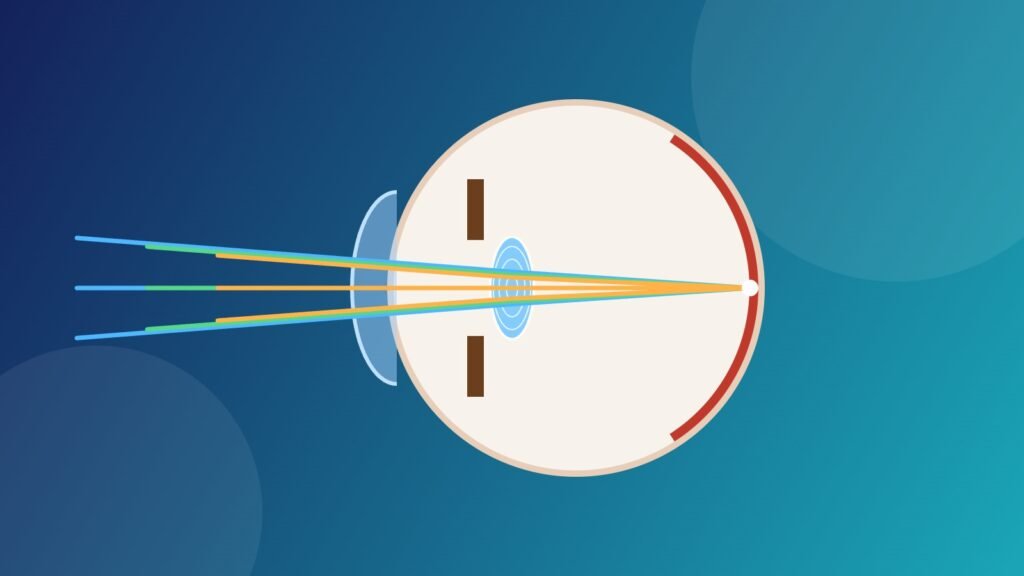
The lens focuses all incoming light to a single point, which gives the clearest possible image at the distance it is set for.
- Aspheric design: J&J says TECNIS lenses correct spherical aberration (a blur that grows in dim light) to essentially zero, which helps contrast at night.
- Low colour blur: the maker states its material causes the least chromatic aberration among lens materials.
- Toric II: has squared, frosted haptics (the arms that hold the lens) to grip the capsule and resist rotation.
How does it compare with other lenses?
| Lens type | Distance | Computer / arm’s length | Reading and mobile | Night halos and glare |
|---|---|---|---|---|
| Standard monofocal (TECNIS 1-Piece) | Clear | Often needs glasses | Needs glasses | Least |
| Enhanced monofocal (Eyhance) | Clear | About one line better | Needs glasses | Least to low |
| EDOF (PureSee, Symfony) | Clear | Good | Partial | Low to moderate |
| Full range (Odyssey) | Clear | Good | Good | Most likely |
In the US Symfony trial, 31.1% of people with this monofocal lens in both eyes could see 6/6 at intermediate distance without glasses, compared with 74.8% with Symfony (source).
Who may be a good candidate?
- People who want the sharpest, most natural distance vision and are happy using reading glasses.
- Frequent night drivers and people who dislike any risk of halos.
- People with retinal disease, macular degeneration, glaucoma, diabetes affecting the eye or other eye conditions, where premium lenses may not help.
- People who want a reliable lens with the longest track record.
- People with astigmatism who want clear distance without cylinder glasses (Toric II).
Ways to get more out of a monofocal lens
- Target choice: both eyes can be set for distance, or for intermediate if you mainly use a computer.
- Mini-monovision: one eye set slightly near-sighted for reading and the other for distance. Some people manage most tasks without glasses this way. It needs careful discussion and is not for everyone.
What do the studies show?
- In head-to-head studies, the standard TECNIS 1-Piece gives distance vision as good as or slightly sharper than Eyhance, with Eyhance about one line better at intermediate (source).
- Toric II: in a US study of 200 eyes, 100% had rotated 5 degrees or less at 3 months, and average rotation stayed under 1 degree (J&J).
- In the TECNIS Toric 1-Piece trial, the most common adverse event was a second procedure in 3.4% (repositioning or retinal repair), cystoid macular oedema in 2.9% and retinal detachment in 0.6% (J&J safety information).
What patients say about the lens
We looked for real patient experiences. Reddit could not be opened during our research, Quora had mostly doctors’ answers, and Google reviews describe hospitals rather than lenses. The most useful patient discussion was on the patient.info cataract forum. Below is a summary in our own words.
What people liked
- Users describe sharp distance vision and very few night-time light effects.
- One patient with both eyes set for intermediate reports 6/6 distance, a clear computer screen and readers only for long reading or dim light.
- Several call it the "tried and tested" choice, with a longer track record than newer lenses.
- Some patients who had problems with a multifocal or EDOF lens had it exchanged for this monofocal and found relief.
- A Symfony patient with a TECNIS monofocal toric in the other eye noted no significant halos in the monofocal eye.
What people found less ideal
- Reading glasses are needed for books and phones, and often for computer work if both eyes are set for distance.
- Intermediate vision varies from person to person.
- Some early posts describe blurry vision for the first days, which usually settles as swelling clears.
Our takeaway: the TECNIS Monofocal suits people who prioritise clarity and safety over freedom from glasses.
Tests before surgery
- Complete eye examination, including retina and macula.
- Optical biometry to calculate lens power, and corneal mapping for astigmatism.
- Dry eye check and treatment before final measurements.
- Agreeing on the target: distance, intermediate or mini-monovision.
Recovery
- Vision usually improves within days.
- Use your eye drops exactly as prescribed and attend all follow-up visits.
- Avoid rubbing the eye, dust, water and eye make-up until your surgeon allows.
- New reading or distance glasses are usually prescribed after about 4 to 6 weeks.
- See your surgeon urgently for pain, falling vision, increasing redness, new floaters or flashes, or a shadow in your vision.
Risks
Risks are those of any cataract surgery: infection, retinal swelling, raised eye pressure, retinal detachment, corneal swelling and lens displacement. A toric lens can rotate and may need repositioning. Months or years later, the membrane behind the lens can turn cloudy and is cleared with a quick YAG laser.
Frequently asked questions
Is a monofocal lens "basic" or inferior? No. It is the most widely used lens type and gives excellent quality of vision. It simply focuses at one distance.
Will I need glasses? Yes, usually for reading and often for computer work. With Toric II, many people do not need distance glasses.
What is the difference between ZCB00 and DCB00? They are the same lens. DCB00 comes pre-loaded in an injector.
Is it good if I have glaucoma, diabetes or macular problems? It is often the preferred choice, because it does not split light or reduce contrast.
Can I avoid reading glasses with a monofocal? Mini-monovision can reduce your need for them. Discuss whether it suits you.
Monofocal or Eyhance? Eyhance adds a little intermediate vision with similar side effects. The standard monofocal gives marginally the sharpest distance focus.
How long does the lens last? It is designed to last for life.
Book a consultation
To discuss the right lens and target for your eyes, visit Tewari Eye Centre, C2C, Sector-55, Noida.
This article is for general education and does not replace an eye examination or medical advice. Patient experiences are summarised from public forums and may not represent typical results. TECNIS is a trademark of Johnson & Johnson. Information checked on 27 November 2026.
Sources
- J&J Vision Professional: TECNIS Monofocal 1-Piece / Toric II page
- J&J Vision Professional: TECNIS Toric 1-Piece adverse events (Eyhance safety information)
- PMC: FDA data comparison including monofocal controls
- PubMed: intraindividual comparison of ZCB00 and ICB00
- patient.info forum: Tecnis 1 and Eyhance results
- patient.info forum: feedback on TECNIS 1-Piece ZCB00
- patient.info forum: IOL exchange to monofocal